Your shopping cart is empty!

Каталог дополнений
Useful links
- All news
- All articles
- OpenCart 3 handbook
- Marketplace engine for OpenCart
- Gentleman’s set of modules for OpenCart
- Universal adaptive templates for your online store on OpenCart
- Modules for working with the Max messenger
- Working with AI (artificial intelligence) in OpenCart
- Working with marketplaces Ozone, Wildberries, Yandex.Products and others
How to properly structure modules for OpenCart 3
A module for OpenCart 3 is not only working functionality but also a competent approach to description and support. A poor description can scare off buyers, while the right presentation style increases trust and makes it easier to work with your product.
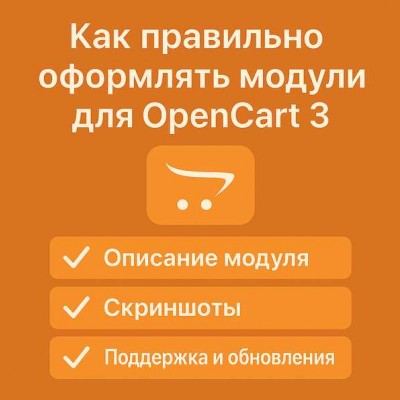
A module for OpenCart 3 is not only working functionality but also a competent approach to description and support. A poor description can scare off buyers, while the right presentation style increases trust and makes it easier to work with your product.
Module description
A competent description increases trust and reduces the number of questions. Add a README file to the archive with instructions on installation, configuration, and compatibility. Duplicate its contents in the module description on the site.
Include:
- Short summary (1-2 sentences about the purpose).
- Detailed description (what it solves and why it is needed).
- PHP and OpenCart versions on which the module was tested.
- Template compatibility (Unishop, Mango, Prostore, etc.).
- Support conditions (terms, format, warranty).
Screenshots
- Must be clear, up-to-date, and in a unified style.
- Show both the admin panel and the storefront.
- With real data, not “Lorem ipsum”.
Specification of technical details
Be sure to clarify:
- PHP and OpenCart versions on which the module was tested.
- Compatibility with ocStore.
- Supported templates and modules. If your module is related to checkout, pricing, payment, or shipping, be sure to specify its compatibility with the Simple module.
- Special requirements (ionCube, CRON, API).
Support and updates
To avoid misunderstandings:
- Specify whether installation is included in the price.
- Indicate the period of free support (for example, 90 days).
- State under what conditions the client receives updates.
- Add contact information (email, ticket system, website).
A well-written module description for OpenCart 3 is:
- A complete and clear description with technical details.
- Screenshots demonstrating real operation.
- Clearly defined support and update conditions.
This reduces the number of questions, increases trust, and helps sell the module more effectively.
Recommended to read