Your shopping cart is empty!

Schema.org micromarkup (JSON-LD)
Price: 860 ₽

Author: no_ti
Write to the author
Sales: 2 (Average rating 0 на основании 0 отзывов)
Need paid help? Contact the site administration
Opencart version:
Sales: 2 (Average rating 0 на основании 0 отзывов)
Need paid help? Contact the site administration
Opencart version:
LiveStore 3.*OCStore 3.*OpenCart 3.*
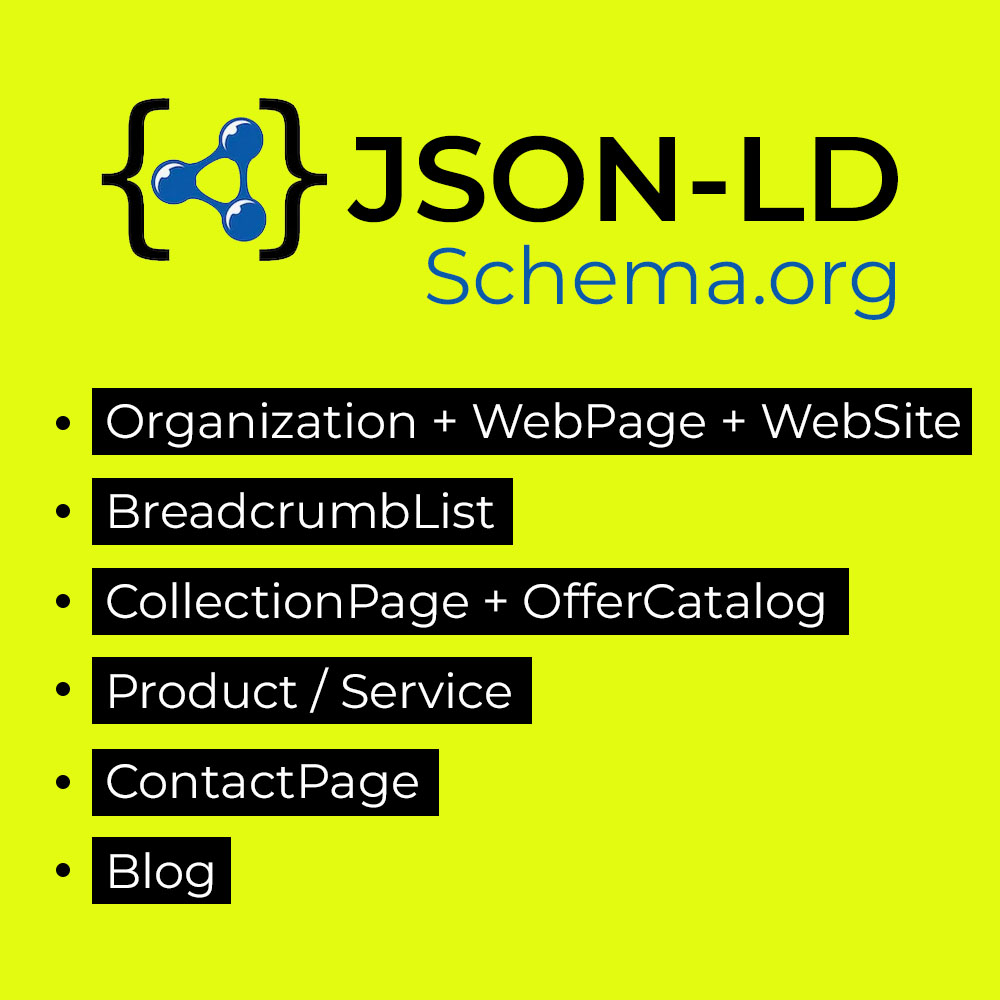
The module adds markup according to the Schema.org standard in json-ld format.
Example Organization + WebPage + WebSite:https://demo-oc.4opencart.ru/demo_3/
Example CollectionPage + OfferCatalog:https://demo-oc.4opencart.ru/demo_3/index.php?route=product/category&path=0_1
Example Product:https://demo-oc.4opencart.ru/demo_3/index.php?route=product/product&product_id=360
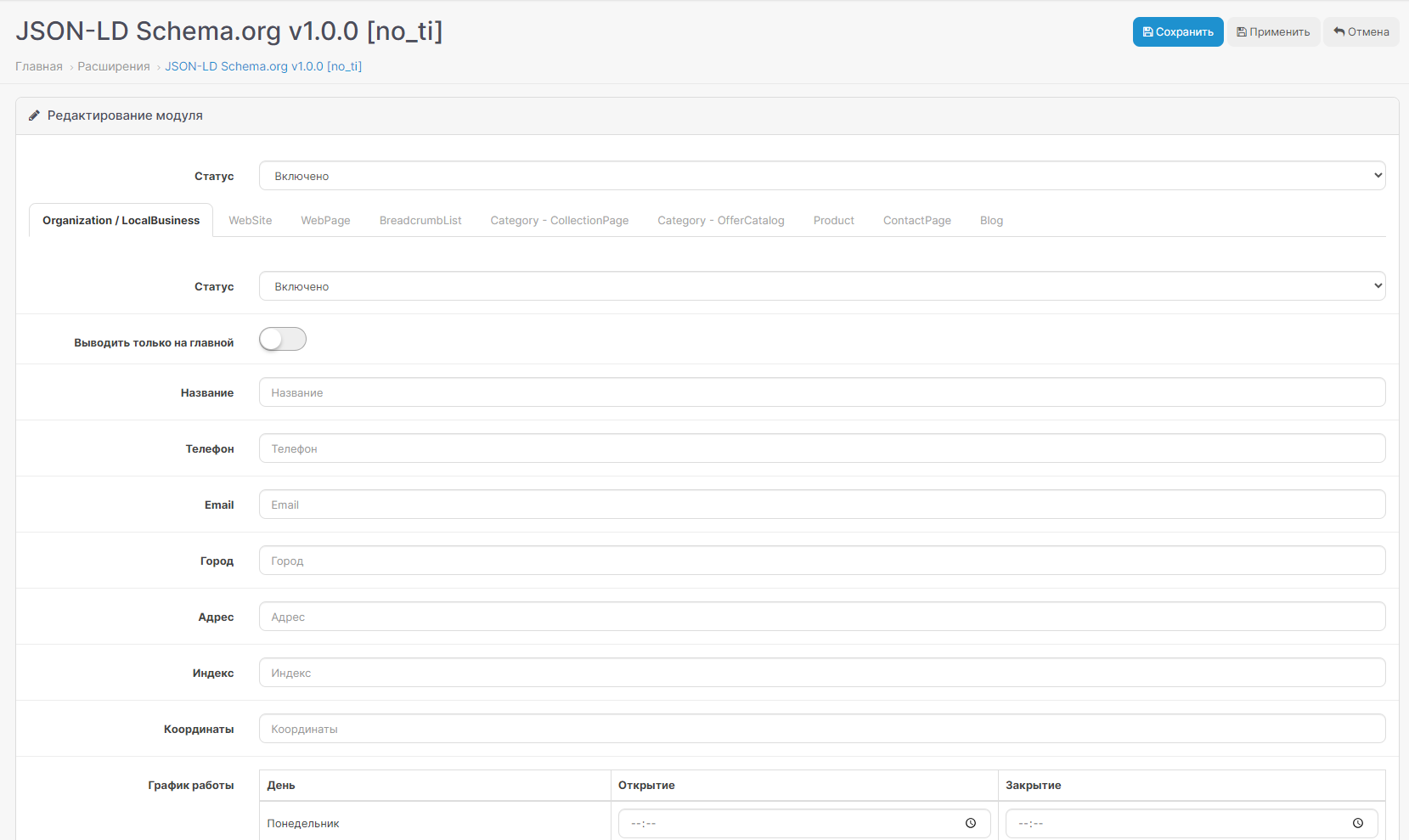
Administrator demo:https://demo-oc.4opencart.ru/demo_3/admin/index.php?route=extension/module/noti_schema_org
(password demo login demo)
You can check the validity of the code here: https://validator.schema.org/
Module capabilities✔ Schemes support:
✔ Output of circuits only on the firstcategory pages (CollectionPage, OfferCatalog) and only on the main page of the site (Organization), or everywhere.
✔ Flexible settings for Organization.
✔ Does not create additional load on the site, does not add new queries to the database.
Why JSON-LD?
1. Code purity
Microdata: You weave attributes (itemscope, itemprop) directly into HTML tags. This clutters the layout, interferes with front-end developers and often breaks when changing the design.
JSON-LD: The script is located in a separate block (usually in the orat the end of ). The data is completely separated from the presentation. You can redesign the entire site, and the markup will remain intact.
2. Flexibility and extensibility
JSON-LD is much easier to implement graph relationships.
For example, you have an article, author, organization and location of the event. In Microdata you would have to nest blocks within blocks, creating a confusing hierarchy.
In JSON-LD you can use @id (URI) for relationships. You describe the Organization once, and then the article simply states "author": {"@id": "https://site.com/#organization"}. This allows you to build a connected semantic network without duplicating data or confusing the bot with nesting.
3. Ability to describe the “invisible”JSON-LD allows you to add structured data about what is not on the screen, but is important for understanding the context.
4. Search engine priority
Google, Yandex, Bing officially state that they prefer JSON-LD. Although they support all formats, in the Google documentation almost all examples are given in JSON-LD.
Example Organization + WebPage + WebSite:https://demo-oc.4opencart.ru/demo_3/
Example CollectionPage + OfferCatalog:https://demo-oc.4opencart.ru/demo_3/index.php?route=product/category&path=0_1
Example Product:https://demo-oc.4opencart.ru/demo_3/index.php?route=product/product&product_id=360
Administrator demo:https://demo-oc.4opencart.ru/demo_3/admin/index.php?route=extension/module/noti_schema_org
(password demo login demo)
You can check the validity of the code here: https://validator.schema.org/
Module capabilities✔ Schemes support:
- Organization
- WebPage
- WebSite
- Product / Service - to choose from in the category or / and product card
- CollectionPage for categories or/and OfferCatalog
- ContactPage
- Blog / BlogPosting for OcStore / LiveOpencart / Mango blog (template)
✔ Output of circuits only on the firstcategory pages (CollectionPage, OfferCatalog) and only on the main page of the site (Organization), or everywhere.
✔ Flexible settings for Organization.
✔ Does not create additional load on the site, does not add new queries to the database.
Why JSON-LD?
1. Code purity
Microdata: You weave attributes (itemscope, itemprop) directly into HTML tags. This clutters the layout, interferes with front-end developers and often breaks when changing the design.
JSON-LD: The script is located in a separate block (usually in the orat the end of ). The data is completely separated from the presentation. You can redesign the entire site, and the markup will remain intact.
2. Flexibility and extensibility
JSON-LD is much easier to implement graph relationships.
For example, you have an article, author, organization and location of the event. In Microdata you would have to nest blocks within blocks, creating a confusing hierarchy.
In JSON-LD you can use @id (URI) for relationships. You describe the Organization once, and then the article simply states "author": {"@id": "https://site.com/#organization"}. This allows you to build a connected semantic network without duplicating data or confusing the bot with nesting.
3. Ability to describe the “invisible”JSON-LD allows you to add structured data about what is not on the screen, but is important for understanding the context.
4. Search engine priority
Google, Yandex, Bing officially state that they prefer JSON-LD. Although they support all formats, in the Google documentation almost all examples are given in JSON-LD.
Distribution method:
Paid
Opencart version:
LiveStore 3.*OCStore 3.*OpenCart 3.*
PHP verision:
PHP 5.5PHP 5.6PHP 7.0PHP 7.1PHP 7.2PHP 7.3PHP 7.4PHP 8.0PHP 8.1PHP 8.2PHP 8.3
Activation:
Manually, upon request via email
Getting files:
On site, in the personal account
Protection system:
Custom
VQmod:
No
Ocmod:
Yes
Events:
No
Uploaded:
08.08.2026
Updated:
09.08.2026
Viewed:
972
Sales:
2
Write a review
Your Name:Your Review: Note: HTML is not translated!
Rating: Bad Good
Enter the code in the box below:
Файлы будут доступны после покупки


