02.10.2026
Частенько за плюшками для опенкарта заглядяывал сюда)




Having your own online store of clothes and shoes is not necessarily an expensive and complicated project. If you already have an assortment, photos and an understanding of your audience, you can start a website with a small catalog and a basic set of functions.
This format is especially suitable for local stores, showrooms and private label manufacturers. The site allows you to accept orders around the clock, display the entire range, organize pickup and fitting, set your own prices and work directly with customers.
Sales often start with social networks, ads or marketplaces. This is convenient for the first start, but over time the business begins to depend on the rules of a third-party site: commissions, requirements for product cards, conditionsdelivery, promotion and participation in promotions.
Your online store allows you to develop not a page inside someone else’s system, but your own trading platform. OpenCart is well suited for its creation - a free, open-source system that can be installed on your chosen hosting and gradually modified to suit your needs.
Clothes and shoes are products that are difficult to fully represent with one photo and a short description. It is important for the buyer to see the style, fit, material, available sizes and colors. For shoes, the length of the insole, fullness, sole material and features of a particular model may also be important.
On the marketplace, the product card follows the general format of the site and is located next to dozens of similar offers. On your website, you decide how to present the product:
A detailed card helps the buyer choose the right model, reduces the number of clarifying questions and reduces the risk of ordering the wrong size. OpenCart supports product variations, including sizes and colors, and additional features can be added as needed.
To create your own store, it is not necessary to order an individual design, a mobile application and complex automation. You can start with a ready-made solution and gradually develop ittogether with business.
For the first launch you will need:
For initial setup, you can use the ready-made selection “Gentleman’s set of modules for OpenCart”.
OpenCart can be downloaded for free and installed on your own hosting. There is no mandatory monthly fee for using the engine itself.
There will still be expenses: domain, hosting, advertising, acquiring, delivery, and sometimes a template, modules and technical assistance. But they can be controlledon one's own. There is no need to pay for a large set of features that the store does not yet use.
On its website, the seller independently determines the retail price. There is no need to include marketplace commissions, paid promotion within the catalog, or participation in unprofitable promotions in advance.
This is especially important for manufacturers of their own clothing and footwear. The price can be calculated based on actual cost, packaging, advertising and desired profit. The owner decides when to hold a sale, whether to give a discount to regular customers, accept pre-orders or release limited collections.
Products atThis can be stored in a store, showroom, workshop or in a small own warehouse. It is not necessary to transfer all sizes and colors to a third-party site in advance.
In OpenCart, you can take into account the remaining stock of products and their variants, hide missing sizes, accept pre-orders, reserve items for trying on, and return items to sale after a buyer refuses.
A small store does not need to immediately deliver goods throughout the country. It is often more profitable to start from your city or region, where it is easier to organize delivery, exchange and personal communication with customers.
A local store can offer:
On the website you can immediately indicate the delivery territory, addresses of retail outlets, courier costs and fitting procedures. The buyer understands where the goods are located, who the seller is and where to go if an exchange is necessary.
A website can also complement a brick-and-mortar retail outlet. The client studies the assortment in advance, checks the availability of the required size and reserves the product. The seller does not have to every timesend photos in messenger - just provide a link to the product card.
For a manufacturer of his own brand, the website becomes a full-fledged representation of the brand. The domain name, logo, photographs, design, packaging, texts and company history all contribute to recognition.
You can tell where and how clothes are made, who designs the models, what materials are used, and how a specific collection differs from mass offerings. The buyer purchases an item from a certain manufacturer and remembers its name, and not just the platform through which the order was placed.
This is especially important for repeat sales. IfThe size chart suited the client, he liked the quality and service, it was easier for him to return to a familiar store.
On your website, you can offer the buyer a personal discount, bonuses, notification of the arrival of the desired size, early access to a new collection, or participation in a private sale.
This is how we gradually form our own customer base, which does not belong to a third-party trading platform.
You don't need to implement dozens of features to get started. The main thing is to help the buyer find the product, choose the appropriate option and place the order without difficulty.
For a basic clothing and shoe store it is enough:
For a large assortment, filters by size, color, price, season and other parameters are useful. The shoe store can additionally use the insole length, fullness, material, heel height and purpose.
You can add notifications as you growabout size arrival, reviews, quick order, favorites, recommendations of similar models, gift certificates and loyalty program.
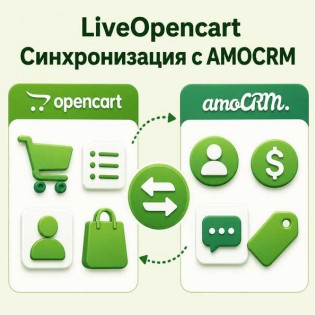
When there are more orders, the store can be linked to 1C accounting system, CRM amoCRMor Bitrix24.
Your own website and marketplaces can work simultaneously. The Marketplace is convenient to use to introduce new audiences to products and sell popular models. Your own store - for a full range, new collections, brand development and repeat orders.
Products from OpenCart can be uploaded to external sites using integrations. This allowsuse several sales channels and do not depend on only one of them.
The main thing is that the main assets of the business - catalogue, brand, customer base and order history - remain under your control.
First, determine the assortment, location of goods storage, delivery area and methods of receiving the order. After this, you can proceed to launch:
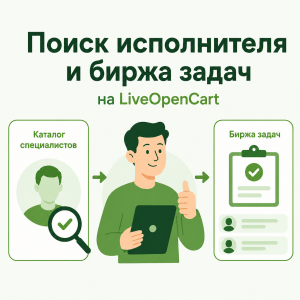
You don't have to have thousands of products to launch. You can start with one collection or several dozen models. If you don’t want to deal with the technical part yourself, you can find a specialiston executor exchange or publish a separate task.
An online store requires the attention of the owner, but launching it does not have to be expensive and technically complex. At the first stage, a small catalog, a ready-made template and basic payment and delivery methods are enough.
The website helps you beautifully present your assortment, manage sizes and stock, organize fittings and pickup, accept orders directly and develop your own brand.
At the same time, the store really belongs to you. You decide for yourselfprices, design, discounts, delivery methods and rules for working with customers. And you add additional functions gradually when the business really needs them.